
How much mathematics do you need to study machine learning?
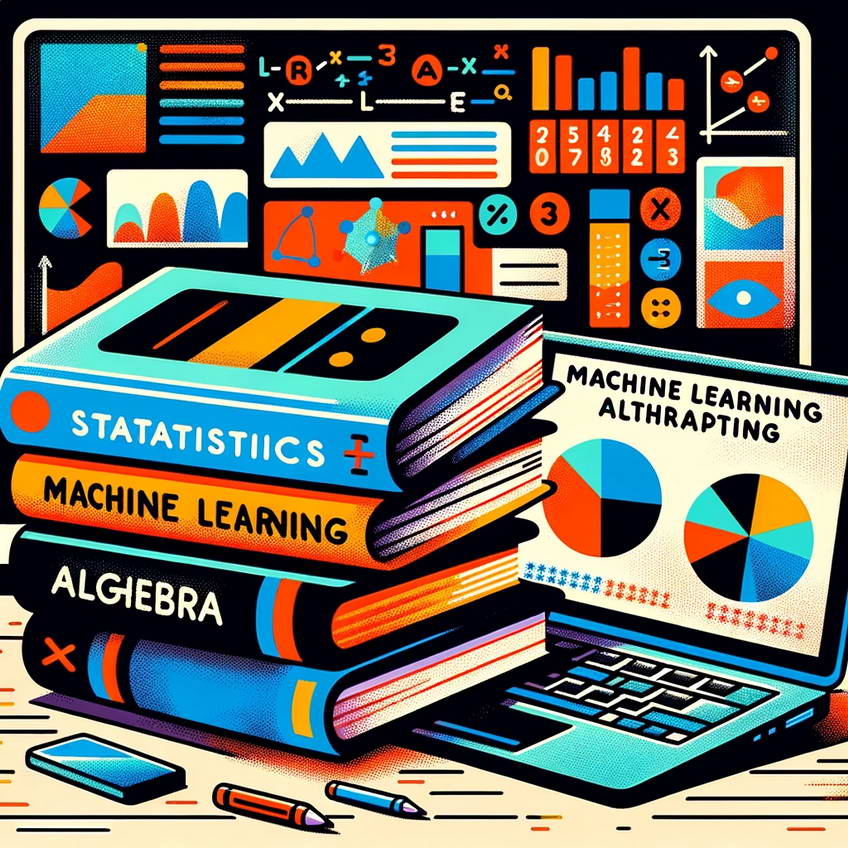
How much mathematics do you need to study machine learning?
Machine learning is rapidly becoming part of everyday life, and more and more people want to master it. But a question keeps coming up: how well do you need to know mathematics before you start?
1. Mathematics for beginners in machine learning
At the outset what matters is a grasp of linear algebra and statistics.
- Linear algebra: you should be familiar with vectors, matrices and the dot product. Vectors are used to represent data, for instance, and matrices to transform it.
- Statistics and probability: a basic understanding of means, medians and standard deviations. This is what lets you assess and interpret the results your models produce.
- Calculus: understanding derivatives and integrals will help you with optimisation problems such as gradient descent.
2. Higher mathematics for machine learning specialists
- Matrix computation: understanding matrix operations such as multiplication and inversion is critical when working with neural networks.
- Optimisation theory: the methods for finding the extrema of functions are what training a model rests on.
- Advanced statistical models: Bayesian methods, for example, which let you account for uncertainty in both the data and the model's predictions.
3. Examples from practice
- Recommender systems: built on algorithms rooted in linear algebra, such as singular value decomposition.
- Computer vision: uses the concept of convolution from calculus to analyse images.
- Natural language processing: statistical models such as Markov models and latent topic models rest on probability theory.
4. Do you need mathematics to use machine learning libraries?
Modern libraries such as TensorFlow and scikit-learn make building and training models far easier. But without understanding the mathematics behind them you risk becoming an operator rather than a developer. Knowing the maths is what lets you understand how the algorithms work at a deeper level and how they can be improved.
In closing
Machine learning is a field where mathematics plays a central role. To get started, school-level knowledge and a basic grasp of undergraduate material is enough. For more serious work you will need a solid command of higher mathematics. Either way, time invested in mathematics pays back many times over and opens up the whole world of machine learning to you.