Why Python is a good language to build a career on
For three years running Python has topped the list of the most in-demand programming languages, leaving even C++ and Java behind. It is used on projects of every size, and in the USA it opens up a very wide range of later specialisms. People usually choose Python for their careers when they plan to do back-end web development, write scripts or build complete digital products end to end. And that is far from the whole picture.
What makes Python strong
Python's strengths explain exactly why it became so popular:
- Simple syntax. Guido van Rossum designed it so that anyone with basic English could start coding straight away. To get a program to print a phrase takes just five or six lines of code.
- Suited to work of any size and kind. You can build almost anything with it, from the simplest photo editor to a game or an application with AI built in.
- Cross-platform. Programs written in it run equally well and equally reliably on every major operating system.
Given those strengths, developers use Python about as widely as a language can be used. They effectively become general-purpose programmers, and a great many companies in America and elsewhere want someone like that on staff. So the case for learning Python is a strong one, even if you know nothing about the language yet or what can be built with it. All of that is covered on a course in a short time.
Where a Python developer's career leads
Python developer vacancies in the USA offer an average salary of around $110,000 a year, varying by specialism. There are several directions to grow in: analytics, development, testing, machine learning and more. The start of a Python career is the most consequential step, and it is better not to rush the choice of specialism.
Where Python is used in tech
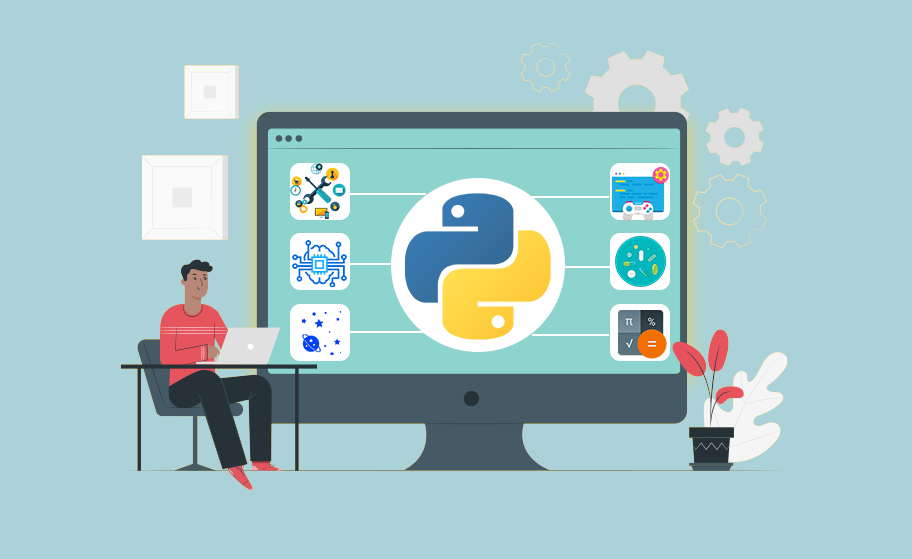
Prospects for Python developers in America are good, and the best vacancies cluster in these areas:
- Web application development. Django and Flask are used for server-side logic, FastAPI for higher-level APIs. You can build a career as a web developer or a RESTful API specialist.
- Data analysis and data science. You will need libraries such as Pandas, NumPy, Matplotlib, Seaborn, Plotly, Scikit-learn, TensorFlow and PyTorch. Beyond analyst and data scientist, there is also the path of the machine learning engineer.
- Automation and DevOps. System administrators and DevOps engineers make heavy use of Python to automate processes and build scripts and tooling.
- Games and prototypes. Developers use Pygame for 2D games and Godot for more ambitious projects with scripting support.
- Embedded systems. Largely the domain of IoT engineers, who use Python to program microcontrollers and connected devices.
- Cybersecurity. The language suits building vulnerability scanners, analysing traffic and creating security testing tools, which is why penetration testers reach for it.
- AI-based applications. You can build a career as an AI/ML developer or an NLP engineer using tools such as TensorFlow, PyTorch, Keras, NLTK and spaCy.
And that is not the whole list. Python is already used heavily in financial analytics, fintech, scientific research and computation. The language is relevant even in consulting and teaching.
Python's reach keeps widening, and over the next few years AI integration, virtual and augmented reality and the Internet of Things will all leave their mark. Knowing this language gives you every chance of joining the tech community and moving up quickly, even if you are a complete beginner today.